
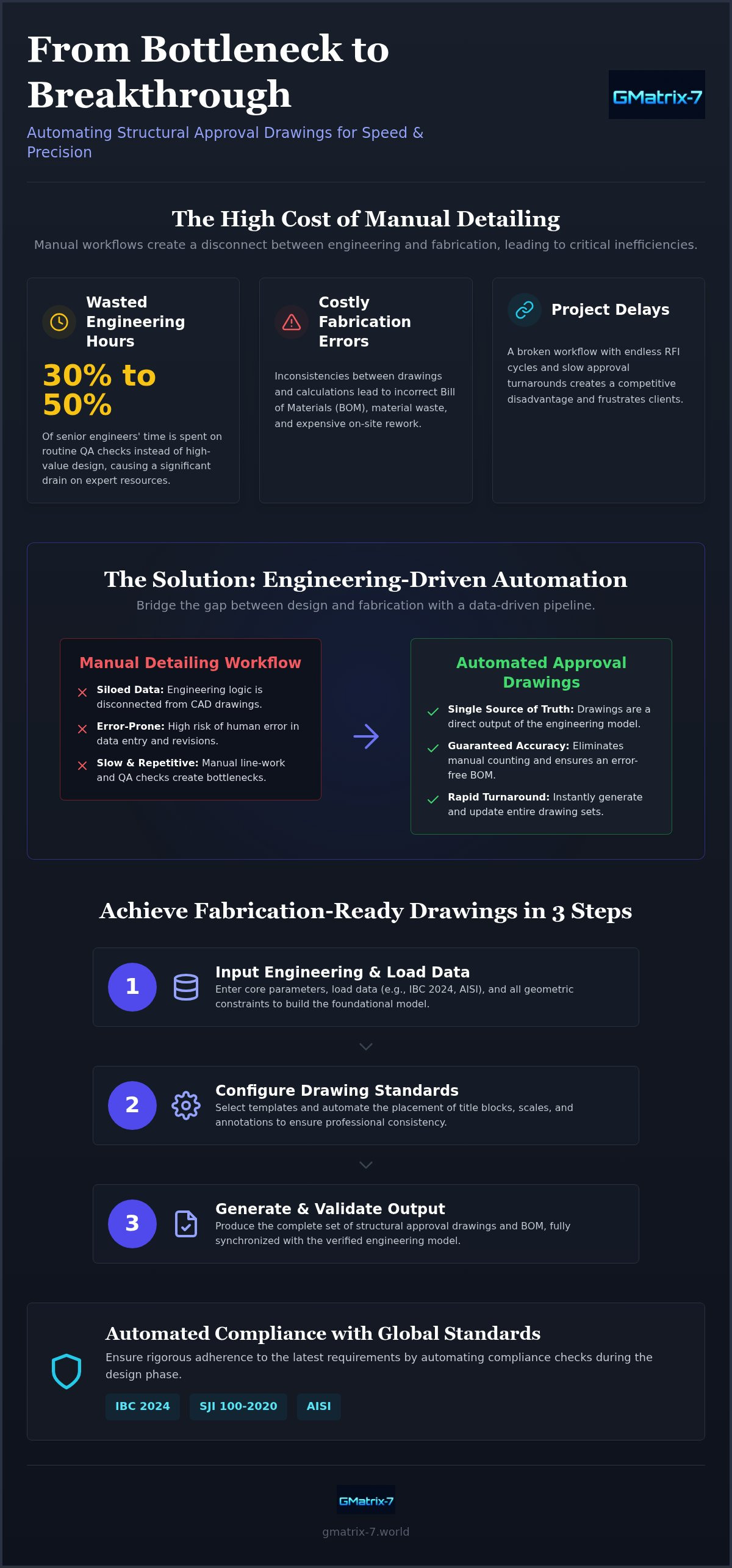
Did you know that engineering firms leveraging automated review processes for structural documentation now report a 30% to 50% reduction in the time senior engineers spend on routine quality assurance? This shift toward automated structural approval drawings isn't just about speed; it's about reclaiming the precision that manual drafting often compromises. You've likely felt the pressure of drafting bottlenecks where inconsistencies between design calculations and final drawings lead to costly material waste. It's a frustrating reality when engineering intent gets lost in translation before it reaches the fabrication floor.
Mastering the transition from manual drafting to automated, engineering-driven documentation is the most effective way to accelerate project approvals and eliminate fabrication errors. By integrating engineering inputs directly into shop drawings, you'll ensure that every Bill of Material is error-free and ready for immediate production. This article explores the technical processes that transform complex inputs into streamlined, fabrication-ready outputs, ensuring your projects meet the latest IBC 2024 and SJI standards while allowing your team to focus on high-value problem solving instead of repetitive drafting tasks.
Key Takeaways
- Identify the operational inefficiencies of manual detailing and learn how to resolve the disconnect between engineering logic and final documentation.
- Discover the technical workflow for generating automated structural approval drawings using specialized modules for Metal Building Systems and Open Web Steel Joists.
- Ensure rigorous adherence to global standards by automating compliance with SJI 100-2020 and IBC 2024 requirements during the design phase.
- Eliminate manual counting and fabrication errors by synchronizing your structural drawings with an automated Bill of Material for immediate production.
- Accelerate your project approval timelines by transitioning from complex manual drafting to a data-driven, streamlined engineering output.
The Bottleneck: Why Manual Structural Detailing Fails in 2026
Manual structural detailing has become a significant liability for firms operating in 2026. The widespread adoption of IBC 2024 standards, alongside updated wind load maps and complex mass timber provisions, has made manual compliance nearly impossible to maintain without sacrificing profitability. When engineering calculations and final drawings exist in separate silos, the resulting friction creates a broken workflow. This disconnect leads to inconsistencies that are often only discovered during the fabrication phase, resulting in catastrophic material waste and project delays. Transitioning to automated structural approval drawings is no longer a luxury; it's a requirement for survival in a high-precision market.
The Hidden Costs of Traditional Detailing
The financial drain of manual drafting extends far beyond the hourly rate of a detailer. Traditional workflows are plagued by endless RFI cycles that force senior engineers to spend 30% to 50% of their time on routine QA checks rather than high-value design tasks. Every manual revision increases the risk of discrepancies in the Bill of Materials. If a single fastener count is off or a member length is miscalculated during manual data entry, the cost of rectification at the job site can erode the entire profit margin of a Metal Building System (MBS) project. Slow approval turnaround times also create a competitive disadvantage, as clients increasingly prioritize partners who can deliver accurate documentation with speed.
Bridging the Gap Between Engineering and CAD
General-purpose Computer-Aided Design (CAD) Systems were designed for geometric representation, not structural logic. These tools lack the specialized intelligence required to translate engineering inputs directly into shop drawings without human intervention. To achieve true efficiency, you must shift toward a data-driven pipeline where the engineering model serves as the "Single Source of Truth." By using specialized design modules, you eliminate manual line-work and ensure that automated structural approval drawings are a direct reflection of the design calculations. This capability-to-outcome pattern ensures that when an input changes, the entire documentation set updates instantly, maintaining rigorous accuracy across the project lifecycle. Establishing this unified pipeline is the only way to maintain a bold, ambitious stance in an industry that demands both excellence and efficiency.
Steps to Automate Structural Approval Drawings
Transitioning from traditional drafting to a system that produces automated structural approval drawings requires a shift in focus from geometry to engineering logic. You don't start with lines; you start with data. Selecting the correct specialized module, such as GMatrix-7 / OWSJ (SJI) or GMatrix-7 / LGS (AISI), ensures that the automation engine understands the specific structural requirements of your project. This methodical approach transforms technical inputs into professional, fabrication-ready documentation without the friction of manual intervention.
Step 1: Inputting Engineering and Load Data
Begin by inputting core engineering parameters directly into the GMatrix-7 engine. This includes IBC 2024 and AISI parameters, as well as specific load data for components like sandwich panels or composite decks. The software's capability to generate accurate load tables for composite decks ensures that your engineering intent is preserved throughout the process. Before moving to the generation phase, you must verify all geometric constraints, including bay spacings, eave heights, and roof pitches, to prevent downstream revisions and ensure the model is fundamentally stable.
Step 2: Configuring Approval Drawing Standards
Professionalism dictates that every drawing set reflects high-level corporate sophistication. You can configure approval drawing standards by selecting templates that align with specific fabricator or client requirements. Automation handles the placement of title blocks, scales, and technical annotations, ensuring consistent styling across the entire set. This level of optimization eliminates the risk of human error in labeling and maintains a rigorous standard of excellence. To see how these processes integrate seamlessly into your workflow, explore the GMatrix-7 structural modules designed for world-class engineering firms.
Step 3: Generating and Validating the Output
Once your parameters and standards are locked, execute the automated generation command. The system produces a comprehensive, multi-sheet set of automated structural approval drawings in a fraction of the time required for manual drafting. After generation, perform a digital audit of the outputs against the engineering model to ensure total synchronization. You can then export the final documentation into industry-standard formats for stakeholder review, knowing the output is battle-tested and accurate. Use the following checklist to maintain quality control:
- Verify IBC 2024 and SJI 100-2020 compliance within the input parameters.
- Confirm that all load tables for composite decks match the structural analysis.
- Audit the synchronization between the engineering model and the generated sheet layout.
- Ensure all technical annotations and title blocks meet client-specific standards.
Automating Compliance with SJI and IBC Standards
Manual compliance checks are a relic of a less efficient era. In 2026, the complexity of the International Building Code (IBC) and SJI standards demands a data-driven approach that integrates regulatory requirements directly into the drafting engine. When you generate automated structural approval drawings through GMatrix-7, compliance is not an afterthought; it's a foundational constraint. The software acts as a guardian of safety, ensuring every structural member adheres to the latest global standards without requiring manual oversight or secondary verification cycles.
Achieving Total SJI Compliant Joist Design
Achieving total compliance in joist design requires more than just meeting load requirements. The GMatrix-7 / OWSJ (SJI) module automates the inclusion of critical details like joist bridging and seat requirements directly into the drawing set. It validates joist geometry against SJI 100-2020 standard specifications, ensuring that every component is fabrication-ready. This rigorous validation process eliminates the risk of non-compliance during site inspections. For a deeper technical exploration of these requirements, consult our guide on SJI compliant joist design to understand how these standards are integrated into the automated workflow.
Meeting IBC Requirements for Metal Building Systems
Meeting IBC requirements for Metal Building Systems involves navigating a maze of seismic and wind load maps. The GMatrix-7 / MBS (IBC) module automates these annotations, pulling from the latest ASCE 7-22 wind load data integrated into the IBC 2024 framework. It handles the transition from complex engineering inputs to streamlined outputs by automatically applying local building codes to the drawing set. This level of precision is vital for maintaining project timelines and avoiding costly permit rejections. You can find more details on this integration through our MBS IBC design software resource, which outlines the rules for comprehensive compliance.
Beyond the primary frame, the software generates automated load tables for sandwich panels and single skin cladding. These tables are essential for verifying the performance of the building envelope under extreme conditions. As standards evolve, regular software updates ensure that your automated structural approval drawings remain compliant with the most recent industry shifts. This proactive approach provides the peace of mind that comes from knowing your documentation is always at the cutting edge of engineering excellence and global safety standards.
Linking Drawings to Automated Bills of Material (BOM)
The final stage of a high-performance workflow is the total synchronization between structural documentation and procurement data. When you generate automated structural approval drawings, the system simultaneously creates a comprehensive Bill of Materials (BOM). This eliminates the traditional lag between drafting and material take-off, ensuring that every component shown in the drawing is accounted for in the material list. GMatrix-7 automates the counting of members, fasteners, and panels, removing the human element from a historically error-prone task. This level of precision is essential for maintaining profitability in tight-margin projects where over-ordering or material waste can jeopardize the entire budget.
Eliminating Manual Reconciliation Errors
Traditional manual take-offs are a primary source of project friction. In disconnected workflows, a minor change in member size during the approval phase often fails to update in the procurement list, leading to costly field fixes. GMatrix-7 solves this by treating the engineering model as the single source of truth. Any adjustment to the automated structural approval drawings reflects instantly in the material list. This capability-to-outcome pattern ensures that what you approve is exactly what arrives at the job site. It's a rigorous, data-driven approach that provides the peace of mind necessary for large-scale industrial projects.
Optimizing Material Procurement for OWSJ and LGS
Precision in material procurement is particularly critical for Light Gauge Steel (LGS) and Open Web Steel Joists (OWSJ). Automated BOMs support just-in-time manufacturing by providing fabricators with exact specifications the moment the approval set is finalized. For projects utilizing LGS structural design software, this means every stud, track, and fastener is quantified with absolute accuracy. This optimization reduces the need for on-site modifications and minimizes scrap. By leveraging specialized modules, you can generate automated Bills of Materials that drive industrial progress while maintaining a focused, world-class standard of excellence. The speed of this process allows your team to move from design to procurement in half the time, securing your position as a leader in the structural engineering field.
The GMatrix-7 Advantage for Rapid Structural Approval
GMatrix-7 represents the pinnacle of engineering-driven documentation, positioning itself as the premier choice for firms that demand excellence. By integrating specialized modules such as GMatrix-7 / MBS (IBC) and GMatrix-7 / OWSJ (SJI), engineering departments can finally break free from the constraints of manual drafting. These modules provide a direct translation of engineering logic into automated structural approval drawings, ensuring that every project meets the highest standards of safety and precision. The time-saving benefits are undeniable, allowing teams to move from complex analysis to finalized documentation in half the time previously required.
Scalability for Global Engineering Firms
Global structural projects require a level of adaptability that general-purpose tools cannot provide. GMatrix-7 supports worldwide projects by adhering to rigorous global standards, including IBC 2024 and SJI 100-2020. This commitment to technical superiority earned the brand prestigious industry awards in 2024, cementing its reputation as a world-class entity. Led by the visionary expertise of Dr. Simon B., the platform is designed to be both battle-tested and fundamentally stable. Firms looking to scale their operations will find the GMatrix-7 licensing model easy to deploy, facilitating a seamless transition for engineering departments across different regions. This scalability ensures that your firm remains a driver of industrial progress, regardless of project location or complexity.
Finalizing the Engineering-to-Fabrication Pipeline
The shift from manual CAD to a unified engineering-to-drawing pipeline is essential for maintaining a competitive edge. Code-compliant automation provides the peace of mind that senior engineers need to focus on high-value design challenges rather than routine QA checks. We encourage a strategic move away from traditional methods toward specialized software for steel detailing to eliminate the reconciliation errors that plague manual workflows. For a deeper look at the industry's direction, explore our professional structural design automation outlook for 2026.
Integrating these modules into your existing workflow is a straightforward process that yields immediate results. By visiting the GMatrix-7 homepage, your firm can access a demonstration of automated structural approval drawings in action. This is the moment to move from complexity to simplicity, ensuring your structural documentation is as technologically advanced as the buildings you design. Excellence in engineering is no longer just about the design itself; it's about the efficiency with which that design becomes a reality.
Securing the Future of Structural Engineering Efficiency
The era of manual drafting is yielding to a more rigorous, data-driven methodology. By integrating engineering logic directly into your documentation pipeline, you eliminate the friction of disconnected workflows and ensure that every output is fundamentally stable. You've seen how synchronizing automated structural approval drawings with real-time Bills of Material prevents material waste and accelerates project timelines. Maintaining compliance with IBC 2024 and SJI 100-2020 is no longer a manual burden but a built-in certainty.
Position your firm as a global engineering authority by adopting the technology that earned the 2024 Industry Award for excellence. It's time to reclaim your senior engineers' time and focus on high-value design challenges while the software handles the complexities of professional documentation. Experience Professional Structural Design Automation with GMatrix-7 and secure the peace of mind that comes from world-class precision. Commit to a standard of excellence that drives industrial progress and defines the future of the built environment.
Frequently Asked Questions
How does automated structural approval software ensure code compliance?
Automated structural approval software ensures compliance by integrating engineering logic and regulatory constraints directly into the design engine. The system validates every structural member against pre-defined parameters from standards like IBC 2024 and SJI 100-2020. This prevents the generation of non-compliant documentation. By locking these rules into the workflow, the software acts as a guardian of safety, eliminating the risk of human oversight during the drafting process and ensuring rigorous adherence to global engineering requirements.
Can GMatrix-7 generate drawings for both MBS and OWSJ projects?
Yes, GMatrix-7 features specialized modules for both Metal Building Systems (MBS) and Open Web Steel Joists (OWSJ). The GMatrix-7 / MBS (IBC) module handles complex primary and secondary framing, while the GMatrix-7 / OWSJ (SJI) module focuses on bar joists and bridging requirements. These modules work independently or in tandem to produce automated structural approval drawings that are tailored to the specific technical needs of each steel construction category, ensuring world-class precision across diverse project types.
What is the difference between automated approval drawings and shop drawings?
Approval drawings are intended for stakeholder review to confirm design intent and code compliance before fabrication begins. In contrast, shop drawings provide the granular, part-specific details necessary for the actual manufacturing process. GMatrix-7 streamlines the creation of approval sets by translating engineering inputs into professional sheet layouts. While approval drawings focus on the overall structural assembly and load paths, the system ensures these documents are accurate enough to serve as the definitive foundation for subsequent fabrication-ready documentation.
How much time can my engineering firm save with automated drawing generation?
Engineering firms typically report a 30% to 50% reduction in the time senior engineers spend on routine quality assurance checks. By automating the transition from technical input to sheet layout, you can generate automated structural approval drawings in half the time required by manual CAD methods. This efficiency allows your team to bypass traditional drafting bottlenecks and focus on high-value problem-solving. The result is a significantly accelerated project lifecycle that boosts your firm's overall profitability and competitive edge.
Does the software support SJI 100-2020 and IBC 2024 standards?
GMatrix-7 provides full support for SJI 100-2020 and IBC 2024 standards, ensuring your designs meet the most current regulatory requirements. The software is updated regularly to incorporate the latest wind load maps and seismic provisions found in ASCE 7-22 and the International Building Code. This proactive compliance allows firms to confidently submit documentation for permits, knowing the output is battle-tested against the rigorous global standards that define the modern structural engineering landscape.
How do automated drawings link to the Bill of Materials (BOM)?
Automated drawings are synchronized with the Bill of Materials through a unified data engine. Every structural member, fastener, and panel identified in the drawing set is instantly quantified in the material list. This "single source of truth" ensures that any engineering change made during the approval phase is reflected in the procurement data without manual reconciliation. This seamless integration eliminates counting errors and prevents material waste, supporting just-in-time manufacturing for complex metal building systems and light gauge steel projects.
Is GMatrix-7 compatible with existing CAD workflows?
GMatrix-7 is designed to integrate smoothly with professional engineering workflows by exporting final documentation into industry-standard formats. While the software replaces manual line-work with data-driven generation, the resulting outputs are compatible with the software environments stakeholders use for review and coordination. This ensures a seamless transition from the automated design environment to the broader project ecosystem. You don't need to overhaul your entire department; instead, you optimize the most time-consuming segments of the drafting process for maximum efficiency.
What technical support is available for implementing structural design automation?
Implementation is supported by a team of authoritative experts led by Dr. Simon B., ensuring your firm achieves a world-class deployment. Support includes technical guidance on module configuration for MBS, OWSJ, and LGS systems to align the software with your specific operational needs. This high-level consultancy helps you transition from complexity to simplicity with confidence. You'll receive the professional assistance required to master the platform, ensuring your team can leverage the full power of automated documentation from day one.


