

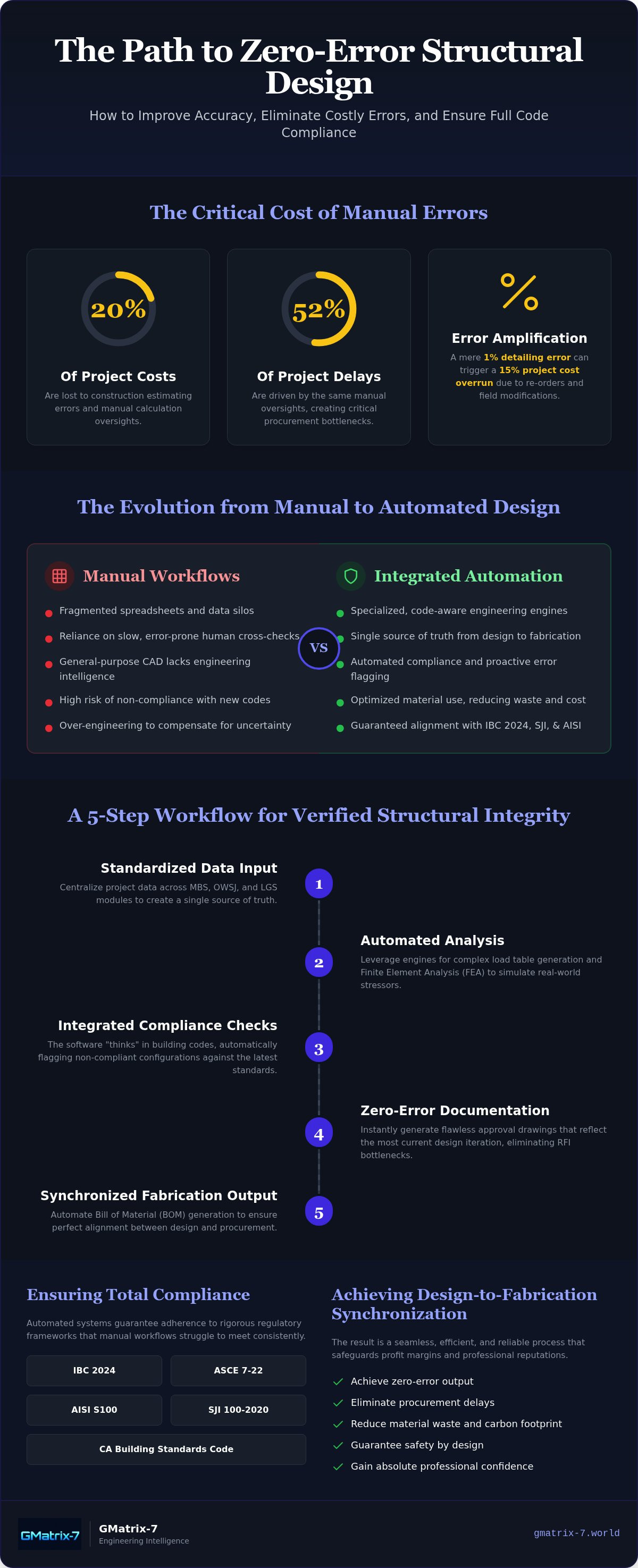
Construction estimating errors and manual calculation oversights currently account for up to 20% of total project costs and drive 52% of all project delays. You've likely felt the pressure of maintaining precision while navigating the 2026 enforcement of the California Building Standards Code or the rigorous ASCE 7-22 load requirements. Relying on manual cross-checks is no longer a viable strategy for high-level engineering firms that value excellence and safety. This guide provides a definitive roadmap on how to improve structural design accuracy by moving beyond human-check variables toward integrated, code-aware automation.
We'll master the technical workflows required to eliminate site-side failures and ensure total compliance with IBC 2024 and AISI S100 standards. You'll learn how to leverage specialized modules like GMatrix-7 / MBS (IBC) and OWSJ (SJI) to generate zero-error documentation and automated Bills of Materials that prevent procurement bottlenecks. We'll also examine the transition from complex design inputs to streamlined, fabrication-ready outputs. By the end of this analysis, you'll possess the strategies needed to achieve total design-to-fabrication synchronization with absolute professional confidence.
Key Takeaways
- Understand how a mere 1% detailing error can trigger 15% project cost overruns, emphasizing the critical need for alignment between theoretical capacity and real-world performance.
- Discover how to improve structural design accuracy by transitioning from manual spreadsheets to specialized engineering engines that automate complex load table generation for sandwich panels and composite decks.
- Identify the engineering intelligence gap between general-purpose CAD and specialized software to ensure long-term ROI in metal building systems and bar joist detailing.
- Implement a rigorous 5-step workflow that standardizes input data across MBS, OWSJ, and LGS modules to guarantee total compliance with IBC 2024 and SJI standards.
- Leverage automated Bill of Material (BOM) and approval drawing generation to eliminate procurement delays and achieve seamless design-to-fabrication synchronization.
The High Stakes of Structural Design Precision in 2026
Structural design accuracy represents the critical alignment between structural engineering theory and the real-world performance of a commissioned building. It's the difference between a project that flows seamlessly into fabrication and one that stalls due to unforeseen site-side failures. In the current landscape, the financial penalties for imprecision are severe. A detailing mistake as small as 1% can trigger a 15% project cost overrun. These costs manifest through emergency re-orders, field modifications, and the administrative burden of resolving RFI bottlenecks. Achieving total precision is the only way to safeguard profit margins and professional reputations.
The engineering industry is undergoing a fundamental shift. We're witnessing a transition from general-purpose CAD tools, which often lack "engineering intelligence," to high-precision automation. This evolution is driven by the need for absolute reliability in global fabrication. Engineers now recognize that knowing how to improve structural design accuracy is synonymous with adopting code-aware technology. With the 2026 enforcement of the California Building Standards Code and the adoption of ASCE 7-22, the room for manual interpretation has narrowed. Precise, data-driven outputs are the new baseline for world-class structural excellence.
The Cost of Detailing Errors in Metal Building Systems
Detailing errors in Metal Building Systems (MBS) do more than just inflate budgets; they compromise the sustainability of the entire project. Material waste remains a significant concern in structural engineering. When manual joist and deck calculations are used, designers often over-engineer components to compensate for uncertainty, leading to unnecessary carbon footprints. Conversely, under-designed elements introduce catastrophic liability and safety risks. Automated detailing eliminates this guesswork. It ensures that every beam, joist, and panel is optimized for its specific load case, reducing waste and providing the pride of high-level achievement in every design.
Regulatory Evolution and Compliance Pressure
Regulatory frameworks like SJI 100-2020 and AISI S100 have introduced a level of technical rigor that manual workflows can't consistently meet. For complex MBS projects, the sheer volume of compliance checks makes human error almost inevitable. This is why the industry is moving toward a culture of "Safety by Design." By integrating automated compliance engines into the workflow, firms can guarantee that every design meets the latest IBC 2024 standards from the first iteration. This proactive approach doesn't just ensure safety; it creates a seamless transition from design to fabrication, allowing projects to move at the speed of modern commerce without sacrificing technical integrity.
Technical Strategies for Eliminating Manual Calculation Errors
Traditional engineering workflows often rely on fragmented spreadsheets that act as static repositories for critical data. These manual systems are liabilities in a high-precision environment. Transitioning from generic spreadsheets to specialized structural engines is the primary step in how to improve structural design accuracy. Modern structural engines don't just store data; they process it through the lens of rigorous building codes like IBC 2024, SJI, and AISI. This shift eliminates the manual transcription errors that occur when moving between calculation sheets and drafting software. By leveraging computational methods such as Finite Element Analysis, engineers can simulate real-world stressors with a level of granularity that human intuition simply cannot match.
Eliminating data silos is essential for maintaining a single source of truth throughout the project lifecycle. Automated engineering documentation ensures that every design iteration updates the Bill of Materials (BOM) and approval drawings simultaneously. This synchronization prevents the procurement of incorrect components, which often results from outdated design versions. High-performance software "thinks" in building codes, meaning it automatically flags non-compliant configurations before they reach the fabrication floor. This proactive error detection transforms the design phase into a rigorous validation process, ensuring that theoretical models translate perfectly into physical structures.
Automating Load Table Generation for Composite Decks
Generating load tables for composite floor decks is a complex task prone to interpolation errors. Manual calculations for varying spans and slab thicknesses often lead to conservative over-designs or dangerous under-estimations. Automated generators solve this by calculating precise values for every unique project parameter. This technology ensures total consistency between the load tables provided to stakeholders and the final approval drawings. Whether you're designing single skin or sandwich panels, real-time generation provides the technical superiority needed to guarantee performance under specified loads. Achieving this level of detail is much simpler when you automate your load table workflows to match modern standards.
Precision in Cold-Formed Steel and LGS Design
Cold-formed steel presents unique challenges due to its thin-walled behavior, which is susceptible to local and distortional buckling. Managing these complexities without manual error requires integrated logic that adheres strictly to AISI S100 standards. Implementing specialized LGS structural design software allows engineers to account for these behaviors automatically. Unlike general CAD drafting, which treats members as simple geometric shapes, specialized LGS tools understand the material properties and structural limitations of light gauge steel. This intelligence ensures that every connection and framing member is optimized for both safety and material efficiency, moving the project from complexity to streamlined output with absolute confidence.
Specialized Engineering Software vs. General CAD: The Accuracy Gap
General-purpose CAD is a drafting utility, not an engineering solution. While standard drafting tools excel at representing geometry, they lack the "engineering intelligence" required to process complex structural logic. In these environments, lines and shapes have no inherent understanding of material properties or building codes. Understanding the technical distinction between these tools is central to how to improve structural design accuracy. When evaluating CAD vs specialized software for steel detailing, the long-term ROI becomes clear: specialized systems prevent the costly "disconnected detailing" where final drawings fail to mirror the underlying engineering calculations. This gap is where most site-side failures originate.
Specialized engineering modules bridge this gap by embedding structural rules directly into the design environment. For example, Open Web Steel Joist (OWSJ) detailing requires a deep understanding of SJI standards that generic CAD simply doesn't possess. Without integrated logic, a detailer must manually translate calculation results into a drawing, creating multiple opportunities for data entry errors. Specialized software automates this transition. It ensures that every joist, beam, and connection is a direct reflection of the validated engineering model. This level of synchronization provides the peace of mind that comes from knowing your documentation is technically infallible.
Why General CAD Fails in Structural Logic
Standard drafting tools operate without automated load path analysis, forcing engineers to perform these critical checks in external environments. This fragmentation creates data silos. Manual Bill of Materials (BOM) generation becomes a primary source of project friction, as any design change requires a manual update across several disconnected documents. Additionally, CAD's inability to generate SJI-compliant joist designs automatically means that compliance is a human-check variable rather than a built-in certainty. These limitations increase the risk of detailing errors that can lead to significant procurement delays and structural safety concerns.
The Advantage of Structural Engineering Automation
Integrated "design-to-detail" workflows eliminate the need for redundant data re-entry. By using a unified system, the engineering inputs directly drive the generation of approval drawings and fabrication data. Real-world validation proves that professional structural design automation secures project approval faster by providing reviewers with transparent, code-compliant documentation. Automated approval drawings significantly reduce revision cycles. They allow your team to focus on high-value optimization rather than tedious manual corrections. This shift doesn't just improve accuracy; it accelerates the entire project timeline from initial design to final fabrication.
Implementing a 5-Step Workflow for Verified Structural Integrity
Establishing a repeatable, data-driven workflow is the most effective method for firms seeking how to improve structural design accuracy. Precision isn't an accident; it's the result of a methodical progression that eliminates human variables at every critical juncture. By moving from raw data to automated validation, engineers can ensure that every output is both code-compliant and fabrication-ready. This five-step technical workflow provides a definitive roadmap for achieving zero-error engineering documentation in 2026.
- Step 1: Standardize Input Data. Centralize all project parameters across MBS, OWSJ, and LGS modules to create a single source of truth.
- Step 2: Deploy Compliance Engines. Utilize automated IBC 2024 and SJI compliance logic to validate the initial design against global safety benchmarks.
- Step 3: Generate Precise Load Tables. Produce project-specific load tables for all cladding and deck systems, eliminating the risks associated with manual interpolation.
- Step 4: Automate the Bill of Materials. Link the structural calculations directly to the material list to ensure that procurement matches the engineering model with 100% consistency.
- Step 5: Finalize with Approval Drawings. Use automated drawing generation to perform a final validation, ensuring that every detail is technically infallible before it reaches the field.
Standardizing Inputs for MBS and OWSJ
Fragmented data is the primary catalyst for structural failures. Creating a centralized data environment for metal building systems ensures that every stakeholder works from the same technical foundation. You can achieve this level of precision by navigating metal building system engineering complexity with specialized tools that harmonize inputs across different design phases. This approach effectively eliminates "transcription errors" that typically occur when moving data between disconnected spreadsheets and drafting platforms. It transforms the design phase from a series of manual checks into a streamlined, high-value technical process.
Automated Documentation and Material Lists
Manual material takeoff is a legacy process that introduces unnecessary project friction. Implementing automated bill of materials software is critical for maintaining accuracy between the engineering model and the physical components delivered to the site. By linking material lists directly to structural calculations, you guarantee that every joist, beam, and panel is accounted for with absolute precision. This automation doesn't just improve accuracy; it reduces shop drawing turnaround times by 50%. It allows your team to focus on optimization and excellence while the software handles the rigorous, data-heavy documentation required for modern fabrication. To secure your project's technical integrity, implement automated documentation workflows today.
Achieving Zero-Error Output with GMatrix-7 Engineering Modules
GMatrix-7 / MBS (IBC) represents the pinnacle of metal building system optimization. It transforms the design phase from a series of manual checks into a rigorous, data-driven validation process. By integrating IBC 2024 standards directly into the workflow, this module ensures that every structural component is optimized for both safety and material efficiency. This level of technical superiority is the definitive answer to how to improve structural design accuracy in a high-stakes fabrication environment. The software doesn't just assist the engineer; it acts as an authoritative guardian of precision, ensuring that theoretical models translate perfectly into real-world performance.
The GMatrix-7 / OWSJ (SJI) module guarantees bar joist detailing accuracy by eliminating the risk of manual calculation errors. It automates the generation of SJI 100-2020 compliant designs, providing a seamless transition from complex inputs to streamlined, fabrication-ready documentation. This module handles the intricacies of joist detailing with surgical precision, allowing firms to move forward with the pride of high-level achievement. When combined with the ability to generate precise composite floor deck load tables with zero manual interpolation, the GMatrix-7 suite provides a comprehensive solution for total structural integrity.
Specialized Modules for Specialized Standards
Managing the thin-walled behavior of light gauge steel requires a deep understanding of AISI S100 standards that general CAD tools lack. GMatrix-7 / LGS (AISI) simplifies this complexity by embedding structural logic directly into the software, ensuring that local and distortional buckling are accounted for automatically. This technology is essential for providing SJI compliant joist design for manufacturers who value excellence above all else. Additionally, the impact of automated load table generation on sandwich panel feasibility is profound. It allows engineers to validate performance across varying spans and slab thicknesses without the administrative burden of manual cross-checks, ensuring that every cladding and deck system meets the most rigorous safety benchmarks.
The Future of Structural Engineering with GMatrix-7
World-class structural fabricators are moving toward a "Zero-Correction" workflow where shop drawing revisions are virtually eliminated. GMatrix-7 is the global gold standard for automated engineering documentation because it links every material list and approval drawing directly to the underlying structural calculations. This synchronization provides the peace of mind that comes from total technical reliability. It's time to move away from legacy manual detailing and embrace a future where accuracy is a built-in certainty. Discover the GMatrix-7 suite of structural engineering tools and elevate your firm to a new standard of professional excellence.
Mastering the Future of Structural Detailing
The margin for error in structural engineering has effectively vanished. As global standards evolve and fabrication timelines accelerate, the transition from manual interpretation to authoritative automation is no longer optional. We've explored how to improve structural design accuracy by implementing integrated workflows that harmonize design, detailing, and procurement. By replacing general-purpose CAD with code-aware logic, you ensure that every output is technically infallible and ready for immediate fabrication.
Command total control over your engineering documentation with technology that is SJI 100-2020 Compliant and features Automated IBC 2024 Integration. Utilizing specialized load table generators allows you to eliminate manual interpolation risks and deliver projects with absolute professional confidence. This shift from complexity to streamlined precision represents the new standard for world-class structural excellence.
Optimize your structural accuracy with GMatrix-7 software today and take the lead in modern industrial progress. Your path to zero-error engineering begins with the right technical partner.
Frequently Asked Questions
How does specialized software improve structural design accuracy compared to manual checks?
Specialized software replaces human intuition with code-aware logic to eliminate transcription errors and ensure every calculation adheres to rigid engineering standards. By automating complex inputs, it provides a single source of truth that manual checks cannot maintain. This is the most reliable method for firms wondering how to improve structural design accuracy while scaling operations in a high-stakes fabrication environment.
Can automated detailing really reduce material waste in large-scale metal buildings?
Yes, automated detailing optimizes structural members to their precise load requirements, which prevents the over-engineering common in manual designs. By calculating exact material needs, it reduces scrap and carbon footprints in large-scale metal buildings. This efficiency ensures every joist and beam is utilized to its maximum safe capacity, reflecting a commitment to both technical excellence and sustainable engineering practices.
What are the risks of using general CAD for SJI-compliant joist design?
General CAD lacks the structural intelligence to interpret SJI standards, treating joists as simple geometric shapes rather than engineered components. This creates a dangerous disconnected detailing environment where drawings might not reflect actual load-bearing capacities. Relying on CAD requires manual data translation, which significantly increases the risk of detailing errors and subsequent site-side failures during the fabrication and erection phases.
How do automated load table generators handle composite deck calculations?
Automated generators perform rigorous calculations for varying spans and slab thicknesses without the risk of manual interpolation errors. They process complex parameters to produce precise load tables that are 100% consistent with the final approval drawings. This technology ensures that composite floor decks meet performance benchmarks under specified stressors, providing engineers with total confidence in the accuracy of their technical documentation.
Is GMatrix-7 software compatible with the latest IBC 2024 standards?
GMatrix-7 fully integrates the latest IBC 2024 standards into its MBS, OWSJ, and LGS modules. This native compatibility ensures every design iteration automatically adheres to the most current regulatory requirements. Engineers can move from design to fabrication with peace of mind, knowing their work is battle-tested against the latest global safety benchmarks and building regulations enforced in 2026.
What is the fastest way to generate an accurate Bill of Materials for a metal building project?
The fastest method is using an automated Bill of Material generation tool linked directly to the structural engine. GMatrix-7 synchronizes material lists with real-time engineering calculations, producing comprehensive BOMs in seconds. This eliminates the need for manual takeoffs and ensures that procurement matches the engineering model perfectly, preventing the delays and cost overruns associated with incorrect component orders.
How does automation help in achieving AISI S100 compliance for LGS structures?
Automation manages the complex thin-walled behavior of light gauge steel, such as local and distortional buckling, through integrated software logic. GMatrix-7 / LGS (AISI) applies AISI S100 standards automatically during the detailing phase. This ensures that every framing member and connection is optimized for safety and material efficiency, removing the human-check variable from the cold-formed steel design and validation process.
Can GMatrix-7 generate approval drawings automatically for sandwich panels?
GMatrix-7 provides advanced modules specifically for generating professional approval drawings for sandwich panels and single skin systems. The software automates the creation of technical documentation, ensuring every detail is technically infallible and ready for reviewer sign-off. This reduces revision cycles and accelerates project timelines by providing a seamless transition from complex design inputs to fabrication-ready technical outputs for global structural projects.


