
In a market where structural steel costs average $2,660 per ton, losing up to 15% of your total project budget to preventable rework is a strategic failure that modern engineering cannot excuse. You recognize that manual data entry remains a persistent liability, often resulting in material mismatches and compliance gaps that stall approval cycles. Reducing errors in steel detailing requires more than just diligence; it demands an uncompromising shift toward automated precision and rigorous structural standards.
This guide provides the authoritative framework you need to master the methodologies and high-value tools required to eliminate manual discrepancies. You will learn how to secure total structural compliance and generate a zero-error Bill of Materials from the outset. We will examine the technical processes behind faster approval drawing cycles and the seamless integration of IBC 2024 and AISI S100 standards into your primary workflow. By the end of this analysis, you'll possess the roadmap to transform complex inputs into streamlined, high-performance outputs that protect your margins and your professional reputation.
Key Takeaways
- Quantify the financial impact of rework and understand how precision in the detailing phase protects up to 10% of total project value.
- Discover why transitioning from generic CAD to intelligent structural entities is the most effective strategy for reducing errors in steel detailing.
- Learn how to eliminate procurement failures by automating Bill of Materials (BOM) extraction directly from structural design data.
- Secure total structural compliance by leveraging software that acts as a regulatory firewall for IBC 2024 and AISI S100 standards.
- Explore how specialized modules for MBS, OWSJ, and LGS accelerate approval drawing cycles while maintaining absolute precision.
The Financial and Structural Risks of Detailing Errors
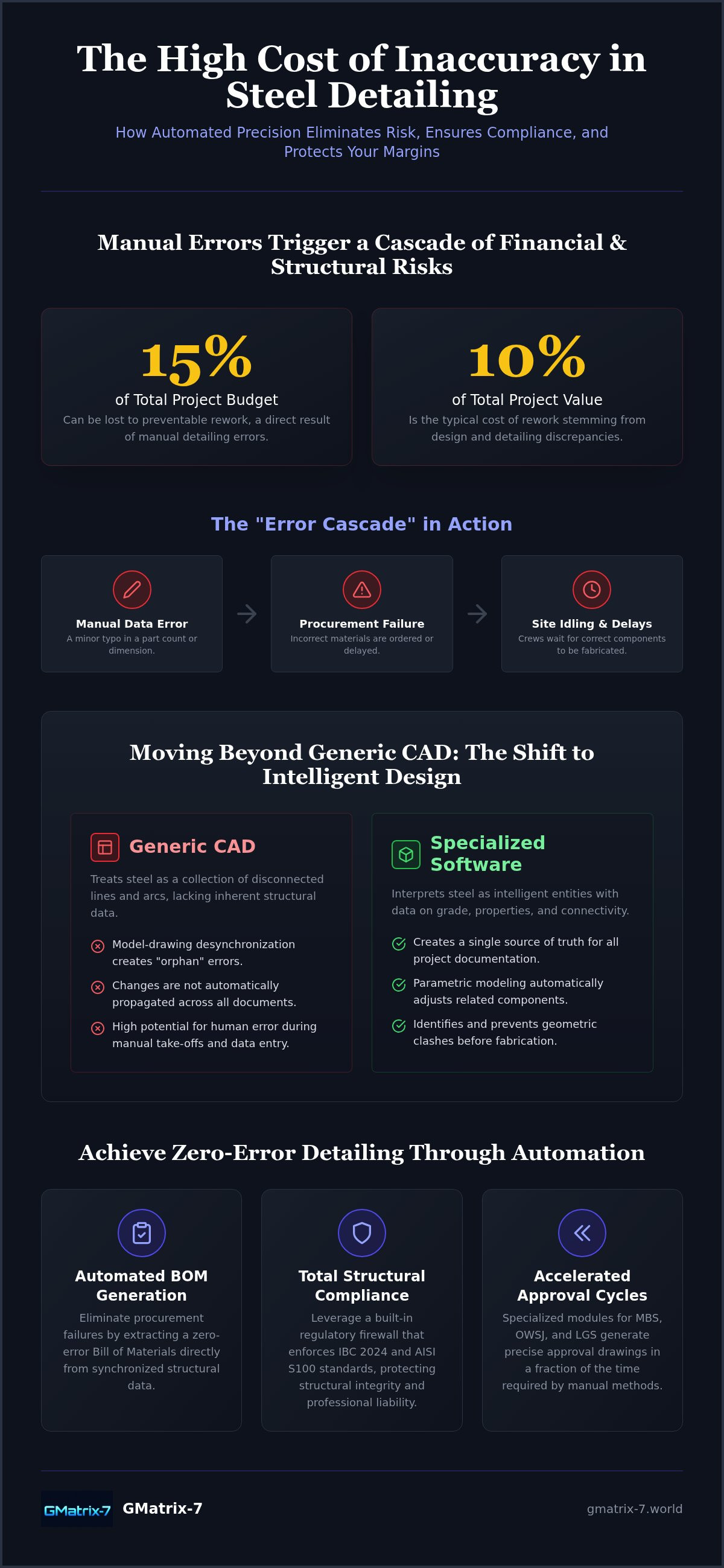
Detailing errors represent the critical disconnect between the engineer's design intent and the fabricator's shop execution. A professional Steel detailer must bridge this gap with surgical precision, yet manual processes frequently introduce vulnerabilities that compromise project viability. Industry data indicates that rework resulting from these discrepancies typically costs between 5% and 10% of the total project value. When you consider that the national average price of structural steel reached $2,660 per ton in July 2026, these percentages represent a massive erosion of profit margins that most firms can't afford to ignore.
A single mistake in a Bill of Materials (BOM) initiates what we define as the "Error Cascade." It starts with an incorrect part count or a minor dimensional typo, which triggers procurement delays. Site idling follows as crews wait for replacement components to be fabricated and shipped. For complex Metal Building Systems (MBS), the sheer volume of data makes manual verification insufficient. Modern engineering demands move too fast for human-only oversight to catch every clash or missing connection in a 2026-scale project.
Common Sources of Manual Detailing Errors
Manual workflows are inherently prone to specific failure points that compromise project speed and accuracy. These vulnerabilities include:
- Data transcription errors: Small typos during manual material take-offs often lead to incorrect part counts or gauge mismatches.
- SJI standard misinterpretation: Complex requirements for bar joists are frequently misunderstood, causing immediate rejection during approval cycles.
- Model-drawing desynchronization: Discrepancies between 2D drawings and 3D structural models create blind spots where design changes are not reflected across all documentation.
Reducing errors in steel detailing requires a sophisticated system that enforces consistency across these data points automatically, ensuring that the final output matches the initial engineering intent.
The Safety Implications of Engineering Inaccuracy
The stakes extend beyond financial loss; engineering inaccuracies directly compromise structural integrity. Detailing errors in Light Gauge Steel (LGS) or MBS can lead to localized load-bearing failures if connection details or gauge thicknesses are incorrectly specified. Engineers face significant professional liability when these discrepancies reach the field. Utilizing specialized software acts as a regulatory firewall against these risks by enforcing code-compliant parameters for IBC 2024 and AISI S100. Safety factor is the ratio of a structural system's absolute strength to its actual applied load, a metric that remains reliable only when automated calculations eliminate human transcription risk.
Moving Beyond Generic CAD: Why Specialized Software Wins
Generic CAD platforms treat structural steel as a collection of disparate lines and arcs. This abstract representation is the primary bottleneck for engineers aiming for absolute precision in a high-stakes environment. Specialized software interprets steel as intelligent structural entities that carry essential data regarding material grade, section properties, and connectivity. This fundamental shift is central to reducing errors in steel detailing because it establishes a single source of truth. When every drawing, Bill of Materials, and load table originates from one centralized database, the risk of "orphan" errors in approval drawings disappears. If you update a connection in the model, the software automatically propagates that change across all documentation, ensuring total synchronization.
Intelligent Entity Modeling vs. Line Drafting
Parametric modeling allows engineers to define logical relationships between components rather than just their static coordinates. Within complex metal building systems, a change to a primary frame member automatically adjusts the secondary framing and joist spacing according to rigorous AISC standards. This intelligence identifies and prevents geometric clashes before they ever reach the fabrication floor. It saves thousands in potential rework costs. You aren't just drafting. You're building a digital twin that recognizes its own structural constraints. This capability allows world-class firms to generate complete structural documentation in hours, a task that previously consumed days of manual labor.
The ROI of Automation in 2026
Operational efficiency in 2026 is measured by the significant reduction in man-hours per ton of steel detailed. Firms leveraging professional structural design automation can bid more competitively because their technical overhead is significantly lower. Automation doesn't just save time; it provides the reliability required for reducing errors in steel detailing on high-stakes projects where margins are tight and deadlines are uncompromising. Adopting these advanced ecosystems is no longer an optional upgrade but a prerequisite for staying relevant in the global construction market. For those ready to lead the industry, exploring specialized engineering modules offers a direct path to this level of operational excellence. The transition from manual oversight to automated precision is the hallmark of a battle-tested, visionary engineering partner.
Eliminating Discrepancies with Automated BOM Generation
The Bill of Materials (BOM) serves as the definitive bridge between engineering design and physical procurement. It's also the industry's most volatile point of failure. Traditional workflows rely on "Double Entry," where data is manually transcribed from drawings into procurement spreadsheets. This repetitive task is the primary cause of material list errors, leading to costly surplus or critical shortages on site. GMatrix-7 eliminates this vulnerability by automating BOM extraction directly from the live structural design data. This process ensures that every piece of steel ordered is exactly what the model requires. Reducing errors in steel detailing requires this level of mathematical parity across all project documentation.
When drawings and material lists exist in silos, discrepancies are inevitable. By unifying the data stream, you achieve total synchronization across the project lifecycle. This transition from manual transcription to automated extraction is a hallmark of world-class engineering firms that prioritize efficiency and safety. You aren't just ordering parts; you're executing a data-driven procurement strategy.
The Anatomy of an Automated Material List
An automated material list functions as a live, data-rich extension of the structural model. It tracks individual bar joist marks, precise lengths, and specific material grades with surgical accuracy. This data integrates directly with fabrication ERP systems to facilitate seamless procurement and production scheduling, effectively removing the manual transcription lag that plagues high-volume shops. By providing exact material counts based on the finalized design, automated BOMs drastically reduce material waste and allow for optimized inventory management. This level of precision is essential for reducing errors in steel detailing and maintaining the high-register professional standards expected in the field. You don't just receive a list; you gain a strategic asset that drives fabrication speed.
Case Study: MBS and OWSJ Material Precision
Managing the complexity of Open Web Steel Joist (OWSJ) detailing requires a focus on granular detail that manual counting can't provide. GMatrix-7 handles these intricate requirements by enforcing SJI 100-2020 compliance in every line item of the generated BOM. This automation is particularly vital for Metal Building Systems (MBS), where a single project may involve hundreds of unique joist configurations. The software verifies every component against global standards, ensuring that structural integrity is never sacrificed for speed. Automated BOMs in complex MBS projects provide a level of granular accuracy that makes manual verification both redundant and obsolete. This rigorous approach effectively positions your firm as a leader in engineering excellence.
Enforcing Compliance: IBC 2024 and AISI S100 Standards
Manual detailing workflows often fall victim to "Compliance Drift," a subtle but dangerous phenomenon where project documentation slowly diverges from the latest building codes. This happens when detailers rely on legacy templates or manual interpretations that fail to account for the rigorous updates in the 2024 International Building Code (IBC). Engineering firms that prioritize reducing errors in steel detailing recognize that specialized software functions as a regulatory firewall. It enforces these standards within the digital environment, ensuring that every beam, column, and connection meets the specified legal requirements. By utilizing LGS Structural Design Software, you embed compliance directly into the modeling process, removing the burden of manual verification from your technical staff.
SJI 100-2020: Automating Joist Design Standards
Adherence to SJI compliance remains one of the most complex hurdles in bar joist detailing. The intricate geometric constraints and load path requirements of the SJI 100-2020 standard leave little room for manual calculation errors. GMatrix-7 / OWSJ (SJI) modules address this by automating compliance checks for every joist in the system. This level of automation significantly reduces the risk of rejection by the Structural Engineer of Record (SER), as the software validates the design against current standards before the drawings ever reach the approval phase. You gain the confidence of knowing your joist detailing is battle-tested and structurally sound from the first iteration.
Generating Compliant Load Tables
The complexity of the AISI S100 standard for cold-formed steel makes manual load calculations for composite decks and sandwich panels a high-risk activity. Transcription errors or miscalculations in these tables can lead to catastrophic structural failures or costly material overruns. Automated generators for single skin and composite floor deck load tables eliminate these vulnerabilities by deriving performance data directly from verified engineering logic. This technology ensures that your load tables are not only accurate but also fully compliant with 2026-level standards. For more information on optimizing this process, refer to our Guide to Composite Deck Load Table Generators. Transitioning to automated load generation is a strategic move that enhances both safety and professional credibility. To see how these tools can fortify your next project, explore our automated engineering modules and eliminate compliance risks at the source.
GMatrix-7: The Future of Error-Free Steel Detailing
GMatrix-7 represents the pinnacle of structural engineering technology, providing a unified ecosystem that addresses the specific complexities of modern construction. While generic tools often struggle with the nuanced requirements of specialized structures, this platform offers dedicated modules for Metal Building Systems (MBS), Open Web Steel Joists (OWSJ), and Light Gauge Steel (LGS). This targeted approach is essential for reducing errors in steel detailing, as it replaces manual guesswork with automated, code-enforced logic. By centralizing your engineering data, GMatrix-7 ensures that every structural entity is modeled with uncompromising accuracy, effectively bridging the gap between the initial design intent and the final shop fabrication.
Specialized Modules for Specialized Structures
The strength of GMatrix-7 lies in its specialized architectural design. Each module is engineered to serve as the gold standard for its respective niche:
- GMatrix-7 / MBS (IBC): This module serves as the ultimate tool for metal building system automation, enforcing IBC 2024 standards from the first frame.
- GMatrix-7 / LGS (AISI): Achieve engineering precision in cold-formed steel by utilizing a system that understands the specific load-bearing constraints of AISI S100.
- GMatrix-7 / OWSJ (SJI): Secure total SJI compliance for bar joists, ensuring that every mark and length is verified against the SJI 100-2020 standard.
These modules do more than just draft; they calculate, verify, and document structural components with a level of precision that manual workflows simply cannot replicate. This automation is the primary driver for reducing errors in steel detailing on high-stakes 2026 projects. You aren't just drafting. You are deploying a data-driven firewall against structural inaccuracy.
Implementation and Workflow Integration
Adopting a new technical standard shouldn't compromise your current project timelines. GMatrix-7 is built for seamless integration, allowing your team to transition to automated workflows without disrupting active engineering cycles. You gain access to world-class support and continuous software updates, ensuring your firm always operates with the most current structural logic and compliance tools. This reliability provides the security and professional pride that come from delivering high-level achievement on every project. Leading global engineering firms are already leveraging these tools to secure their competitive edge in 2026. If you're ready to elevate your operational standards, you can Request a GMatrix-7 Demo and Eliminate Detailing Errors Today. The future of precision is automated, and it starts with a commitment to excellence.
Securing Your Competitive Edge in 2026 Engineering
The transition from manual diligence to automated precision is the defining shift for engineering firms aiming for market leadership. You've seen how reducing errors in steel detailing protects up to 10% of total project value while ensuring total compliance with IBC 2024 and SJI 100-2020 standards. By replacing generic drafting with specialized modules for MBS, OWSJ, and LGS, you establish a rigorous regulatory firewall that eliminates rework and accelerates approval cycles. Automated BOM and drawing generation aren't just conveniences; they're high-value strategic assets that bridge the gap between design and fabrication with surgical accuracy.
This data-driven approach removes the liability of human transcription and replaces it with a battle-tested workflow. Secure your professional reputation and drive industrial progress with a partner that values excellence above all else. Your projects deserve the certainty that only world-class automation provides. Eliminate manual errors with the GMatrix-7 suite of structural design tools. Take the definitive step toward total structural integrity today.
Frequently Asked Questions
What are the most common errors in structural steel detailing?
Common errors include data transcription during manual material take-offs and the misinterpretation of complex SJI standards for bar joists. These discrepancies often lead to material mismatches that cause site rework, which can cost up to 15% of a project's value. Reducing errors in steel detailing requires moving away from manual verification toward automated systems that enforce structural standards by design, ensuring total synchronization across all drawings and material lists.
How does automated detailing software reduce material waste?
Automation ensures that material procurement exactly matches the structural model, eliminating the "safety padding" often added during manual take-offs. By generating a zero-error Bill of Materials, the software optimizes inventory management and prevents the purchase of surplus or incorrect components. This precision reduces the environmental and financial impact of scrapped material on large-scale MBS projects, allowing firms to maintain leaner operations and protect their total project margins.
Is GMatrix-7 compliant with the latest IBC 2024 standards?
Yes, GMatrix-7 is fully built for IBC 2024 compliance across its specialized modules. The software acts as a regulatory firewall, enforcing the latest building codes during the design and detailing phases. This ensures that every structural entity meets global safety standards, mitigating professional liability for engineers and preventing compliance-related rejections during the approval cycle. You don't have to worry about manual code interpretation when the software handles the logic.
Can GMatrix-7 generate load tables for composite floor decks?
GMatrix-7 features advanced tools specifically designed for generating precise load tables for composite floor decks, single skin, and sandwich panels. These automated generators derive performance data directly from verified engineering logic, eliminating the calculation risks associated with manual spreadsheets. This capability ensures that your deck specifications are both accurate and fully compliant with current AISI standards, providing a professional output that is ready for immediate fabrication use.
How does automated BOM generation differ from manual material take-offs?
Automated BOM generation extracts material data directly from the 3D structural model, ensuring 100% parity between design and procurement. Manual material take-offs rely on human transcription, which is the primary source of "Double Entry" errors. Automation removes the risk of typos or missing components, streamlining the transition to fabrication ERP systems without the need for redundant manual checks. It's a faster, more reliable method that transforms a liability into a strategic asset.
What is the benefit of specialized OWSJ software over generic CAD?
Specialized OWSJ software treats bar joists as intelligent structural entities rather than abstract lines. While generic CAD requires manual counting and individual mark tracking, GMatrix-7 / OWSJ (SJI) automates compliance with SJI 100-2020 standards. This intelligence identifies geometric clashes and load path failures instantly, providing a level of precision that generic drafting tools cannot replicate. It allows detailers to focus on high-level achievement rather than repetitive, error-prone counting tasks.
How long does it take to generate approval drawings with GMatrix-7?
GMatrix-7 accelerates the workflow by generating professional approval drawings in a matter of hours rather than days. Because the documentation is driven by a single source of truth within the structural database, updates to the model propagate automatically across all drawings. This rapid generation cycle allows firms to meet aggressive project timelines while maintaining absolute accuracy in their technical submissions. It's an essential tool for maintaining a competitive edge in 2026.
Does GMatrix-7 support Light Gauge Steel (LGS) design according to AISI S100?
GMatrix-7 / LGS (AISI) provides comprehensive support for Light Gauge Steel design, specifically engineered to meet AISI S100 requirements. The module automates the complex calculations necessary for cold-formed steel members, ensuring that every gauge and connection detail meets rigorous structural requirements. This specialized focus is a critical component in reducing errors in steel detailing for light-frame industrial structures, providing engineers with the peace of mind that comes from battle-tested, code-compliant technology.


