
Relying on manual calculations for cold-formed steel is no longer just a bottleneck; it's a structural liability in an industry where the ANSI/SDI AISI S100-2024 standard demands absolute algorithmic precision. You understand that the inherent complexity of local, distortional, and global buckling modes leaves zero margin for error. To maintain a competitive edge, engineers must transition to advanced LGS structural design software that transforms these intricate engineering challenges into streamlined, compliant outputs.
We recognize that manual material takeoffs and slow turnaround times for technical approval drawings are the primary barriers to your firm's scalability. This guide demonstrates how to master the complexities of light gauge steel engineering through automation that ensures total AISI S100 compliance. You'll learn how to reduce your design cycle time by 50%, eliminate material waste with automated BOMs, and secure the peace of mind that comes from world-class structural documentation. We'll examine the technical processes that bridge the gap between complex structural analysis and rapid, data-driven results.
Key Takeaways
- Understand the paradigm shift from manual CAD-based detailing to rule-based automation within modern LGS structural design software.
- Navigate the rigorous requirements of the AISI S100 standard with specialized algorithms designed to solve complex local, distortional, and global buckling modes.
- Streamline your engineering pipeline by automating the generation of professional approval drawings and error-free bills of materials directly from structural inputs.
- Identify the essential framework for evaluating specialized engineering modules against general BIM tools to guarantee structural safety and regulatory compliance.
- Achieve a 50% reduction in design cycle times by implementing a seamless, data-driven transition from initial structural analysis to final documentation.
The Evolution of LGS Structural Design Software in 2026
The global construction sector is undergoing a fundamental transformation, with the light gauge steel framing market projected to reach $37.09 billion in 2026. At the center of this shift is LGS structural design software, a specialized category of engineering technology that has evolved far beyond basic drafting. Unlike general-purpose CAD tools, these platforms are engineered to manage the unique physical properties of Cold-formed steel frames, ensuring that every member meets the rigorous demands of the latest ANSI/SDI AISI S100-2024 specifications. The 2026 industry standard dictates a move away from simple geometric layouts toward comprehensive structural compliance, where the software itself acts as a guardian of safety and precision.
Why Traditional CAD Falls Short for LGS Engineering
Generic CAD environments excel at visual representation, yet they remain fundamentally disconnected from the complex physics of thin-walled steel. These tools often fail to account for the intricate buckling modes, such as local, distortional, and global buckling, that define LGS performance. Relying on manual data entry for these calculations introduces a high risk of catastrophic error. Professional LGS structural design software distinguishes "drawing" from "engineering" by the depth of data integrity involved. It's no longer sufficient to treat steel as a generic material; while a draftsman might produce a visually accurate model, an engineer requires a system that validates structural capacity in real-time.
The Role of Automation in Modern Structural Workflows
Automation is the primary driver of efficiency in the 2026 engineering landscape. By utilizing algorithmic design, firms can bridge the gap between complex inputs and high-value outcomes. Modern professional structural design automation allows for a seamless transition from analysis to documentation. This shift eliminates the redundant manual tasks that once plagued the design cycle.
- Error Elimination: Automated rules prevent common mistakes in member sizing and connection detailing.
- Material Optimization: Algorithmic nesting and automated BOM generation reduce waste by calculating exact requirements.
- Regulatory Speed: Compliance with current North American specifications is built directly into the workflow.
This methodical approach ensures that technical approvals are secured with unprecedented speed. It allows projects to move from the screen to the site without the friction of manual technical review, providing a reliable path to project completion.
Decoding AISI S100: Why Structural Precision Trumps Basic Framing
Engineering excellence in light gauge steel starts with a rigorous adherence to the AISI S100-16 (2020) North American Specification. While many platforms market themselves as "framing software," they often lack the analytical depth required to perform true structural validation. True LGS structural design software must do more than just generate a 3D model; it must execute a multi-layered verification of every structural member against specific load combinations. This distinction is critical because thin-walled steel behaves fundamentally differently than thicker, hot-rolled sections. Without data-driven engineering checks, a visual layout is nothing more than a geometric suggestion that lacks verified safety margins.
Mastering Cold-Formed Steel Buckling Modes
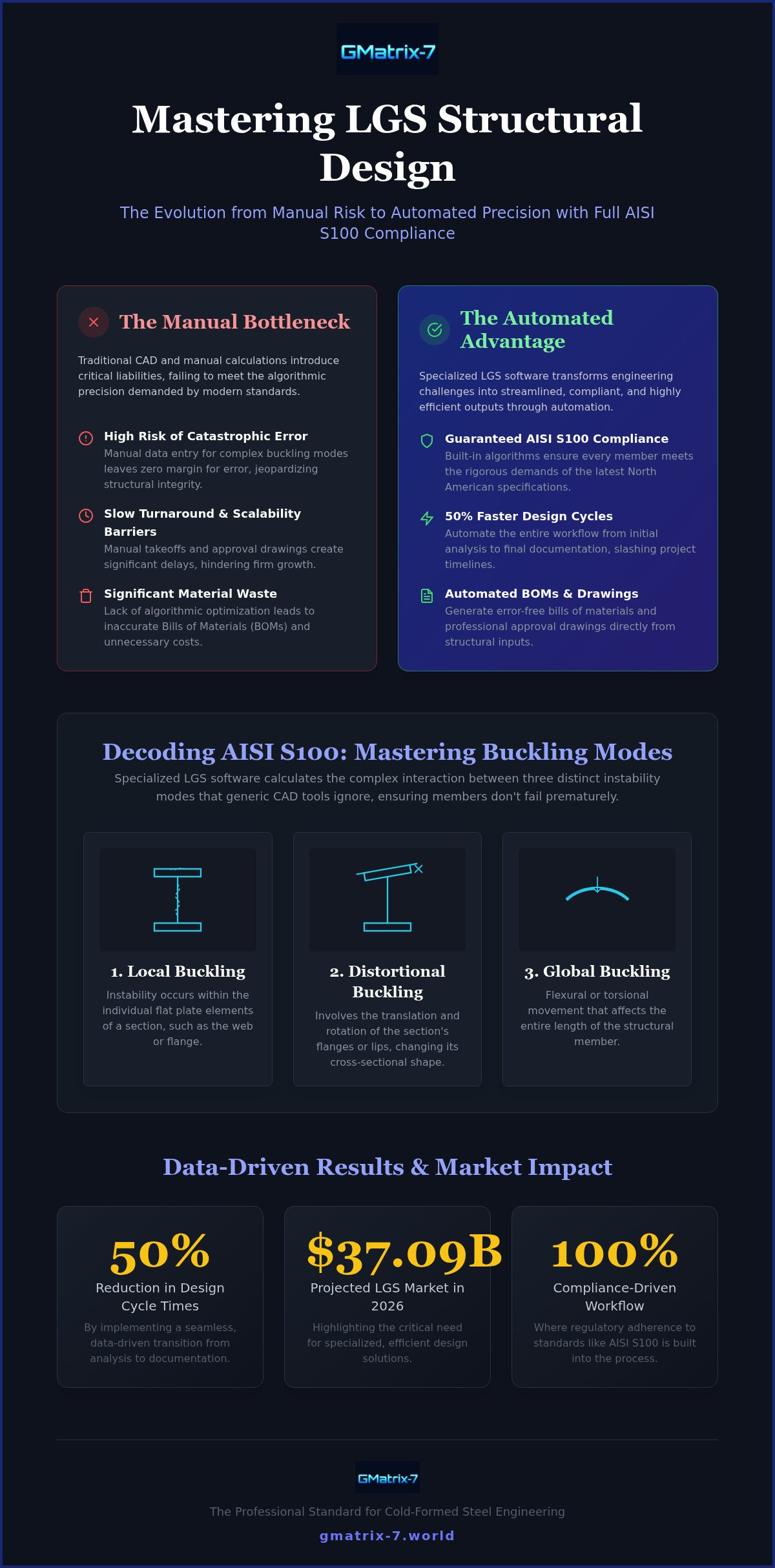
LGS members are prone to three distinct types of instability that occur long before the material reaches its yield point: local, distortional, and global buckling. Local buckling occurs within the individual plate elements of a section, such as the web or flange. Distortional buckling involves the translation and rotation of the section's flanges or lips, often seen in members with open cross-sections. Global buckling affects the entire length of the member through flexural or torsional-flexural movement. Specialized LGS structural design software calculates the complex interaction between these modes to ensure the member won't fail prematurely under service loads. The Direct Strength Method (DSM) provides a sophisticated framework for determining the nominal strength of cold-formed steel members by analyzing the elastic buckling behavior of the entire section rather than individual elements.
Compliance as a Guardian of Structural Safety
In the context of large-scale commercial projects, compliance isn't a bureaucratic hurdle. It's a fundamental guarantor of project stability and financial security. Utilizing non-compliant or "layout-only" software creates a significant liability for the engineer of record, as it bypasses the rigorous data-driven checks necessary to prevent structural failure. By integrating world-class LGS structural design software into your workflow, you ensure that every output is battle-tested against global standards. This commitment to precision provides the peace of mind required for high-stakes achievement. If you're ready to elevate your engineering standards, exploring a dedicated LGS (AISI) module can bridge the gap between basic framing and professional-grade structural integrity.
Evaluating LGS Design Tools: Accuracy, Compliance, and Integration
Selecting a professional LGS structural design software represents a strategic investment in technical authority and operational safety. It's not merely a choice of drafting tools; it's a commitment to a platform that serves as a guardian of structural integrity. While many general-purpose BIM tools offer impressive visualization, they often fail to provide the granular engineering logic required for thin-walled steel. A world-class evaluation framework must prioritize structural accuracy over aesthetic modeling. Engineers require systems that provide a seamless transition from analysis to documentation, ensuring every design decision is backed by rigorous, data-driven validation.
Specialized vs. General-Purpose Structural Software
Generic BIM platforms excel at coordinating complex building systems, yet they often treat light gauge steel as a static geometric object. This approach ignores the critical physics of cold-formed members. In contrast, specialized LGS modules are built on a foundation of physics-based rules that account for the unique behavior of thin-walled steel sections. This distinction is critical when generating advanced load tables or performing interaction checks for local and distortional buckling. Selecting a tool that fundamentally understands these nuances ensures higher precision in the final output. For a deeper analysis of these differences, review our CAD vs specialized software for steel detailing comparison. These specialized environments eliminate the manual workarounds required when using non-native steel tools, allowing engineers to focus on optimization rather than troubleshooting.
Integration with Global Engineering Standards
Professional engineering requires a tool that acts as a world-class consultant, providing immediate feedback on regulatory compliance. Modern software must support the IBC 2024 and AISI standards simultaneously, adapting to regional code variations without manual intervention. This level of sophistication ensures that your firm remains a leader in global construction standards. Seamless data export is equally vital for maintaining a high-register professional standard. The ability to generate an automated bill of materials (BOM) and technical approval drawings directly from the structural model reduces the risk of manual transcription errors. This capability-to-outcome pattern transforms complex engineering inputs into high-value deliverables with unprecedented speed. By prioritizing integration, you secure a stable workflow that bridges the gap between design and physical fabrication, ensuring that the excellence of your engineering is preserved throughout the project lifecycle.
Automating the Engineering Workflow: From Analysis to Approval Drawings
Modern structural engineering demands a transition from manual oversight to algorithmic certainty. By implementing a high-performance LGS structural design software, firms can adopt a rigorous 5-step workflow that ensures both speed and safety. This methodical process begins with defining structural parameters and environmental loads, followed by an algorithmic analysis of member buckling modes. Once the system validates these results against the AISI S100-2024 specifications, it generates technical approval drawings with automated annotations. The final stage involves exporting precise bills of materials and specialized load tables, providing a seamless transition from the digital model to the physical site.
Streamlining Technical Documentation and BOMs
Manual material takeoffs are a notorious bottleneck that introduces significant risk into the project lifecycle. Automation eliminates this hurdle by extracting data directly from the structural analysis, ensuring that the bill of materials (BOM) is an exact reflection of the engineered design. This precision directly impacts project profitability by preventing over-ordering and reducing on-site delays caused by missing components. In 2026, algorithmic precision in detailing has transformed material waste from an accepted project cost into a preventable engineering failure. By automating the documentation phase, engineers provide contractors with professional-grade drawings that facilitate rapid technical approval and clear communication across the supply chain.
Generating Precise Load Tables for Decks and Panels
Calculating the load-bearing capacity of composite floor decks and sandwich panels involves complex variables that generic tools simply cannot handle. Engineers must account for the interaction between the steel profile and the concrete or insulation layers, a task that requires specialized structural logic. Advanced LGS structural design software automates this by generating comprehensive load tables for single skin cladding and composite systems, ensuring that every panel meets local safety requirements. This capability is essential for high-performance buildings where cladding integrity is paramount. If your projects involve complex flooring systems, utilizing a dedicated composite deck load table generator ensures that your engineering data remains accurate and compliant. This automated approach replaces hours of manual calculation with a single, data-driven output, securing the peace of mind that comes from world-class achievement. To optimize your firm's engineering output, integrate GMatrix-7 into your structural design workflow today.
GMatrix-7 / LGS (AISI): The Professional Standard for Cold Formed Steel
GMatrix-7 stands as the definitive LGS structural design software for engineers who refuse to compromise on safety or efficiency. It represents the culmination of years of rigorous development, specifically tailored to meet the exacting demands of modern cold-formed steel engineering. By integrating the GMatrix-7 / LGS (AISI) module into your firm's workflow, you're not just adopting a new application; you're securing a world-class partner that bridges the gap between complex structural theory and practical, high-value outcomes. This platform's engineered to handle the heavy lifting of compliance, allowing your team to focus on the creative and strategic aspects of industrial progress with absolute confidence.
Key Features of the GMatrix-7 LGS Module
The GMatrix-7 / LGS (AISI) module's built around a "capability-to-outcome" architecture that prioritizes structural precision above all else. It automates the most labor-intensive aspects of the design cycle, transforming complex engineering inputs into streamlined, professional deliverables that stand up to the most rigorous technical reviews.
- Automated Approval Drawing Generation: Produce technical drawings with algorithmic accuracy, facilitating faster regulatory approval and reducing technical friction across the project lifecycle.
- Automated Bill of Material Generation: Eliminate the manual material takeoff bottleneck with precise, error-free lists that directly enhance project profitability and reduce waste.
- Advanced Load Table Generation: Calculate exact capacities for single skin cladding, sandwich panels, and composite floor decks with specialized structural logic that handles complex interactions.
- Total AISI S100 Compliance: Ensure every member's validated against the latest North American specifications, providing the peace of mind that comes from battle-tested safety standards.
The GMatrix-7 Advantage: Beyond Software
The true power of GMatrix-7 lies in the authoritative expertise that informs every line of its code. Led by Dr. Simon B., the GMatrix-7 team functions as a high-level consultant for global engineering firms, providing solutions that are both technologically advanced and fundamentally stable. This isn't a generic off-the-shelf product; it's a battle-tested system designed for world-class entities that value excellence. By choosing GMatrix-7, you align your business with a visionary developer of technology that acts as a guardian of safety in a rapidly evolving industry. This partnership ensures that your firm remains at the cutting edge of industrial progress, delivering superior results on every project. Explore the GMatrix-7 LGS (AISI) Module and elevate your engineering standards today.
Securing Industrial Leadership Through Structural Precision
The shift toward high-performance building systems requires a fundamental departure from traditional drafting methods. You've seen how specialized LGS structural design software transcends basic modeling to provide a rigorous, data-driven framework for AISI S100 and IBC 2024 compliance. By integrating these advanced algorithms, your firm can solve complex buckling interactions while simultaneously automating the generation of professional approval drawings and error-free bills of materials. This methodical approach doesn't just improve efficiency; it serves as a guardian of structural safety and a driver of project profitability.
Trusted by global structural engineering firms, GMatrix-7 offers the battle-tested reliability required for world-class achievement. We invite you to Request a Technical Demo of GMatrix-7 LGS Structural Design Software and witness the seamless transition from complex engineering inputs to high-value deliverables. Don't let manual bottlenecks or compliance risks hinder your firm's progress. Secure your position as an industry innovator and embrace the peace of mind that comes from absolute technical excellence.
Frequently Asked Questions
What is the most compliant LGS structural design software for AISI S100-2024?
GMatrix-7 / LGS (AISI) provides full compliance with the ANSI/SDI AISI S100-2024 standard. This version, published in March 2025, requires rigorous algorithmic checks for thin-walled steel members. Professional LGS structural design software ensures that every calculation aligns with these North American specifications. By automating the verification of local and distortional buckling modes, the system provides engineers with the data-driven certainty required for high-stakes industrial and commercial projects.
Can LGS software automatically generate a bill of materials (BOM)?
High-performance LGS structural design software like GMatrix-7 automates the generation of comprehensive bills of materials directly from the structural model. This functionality eliminates the manual transcription errors that often plague the material takeoff phase. By providing an exact list of required components, the system reduces material waste and prevents costly on-site delays. This seamless transition from engineering input to procurement data is essential for maintaining project profitability and operational efficiency in 2026.
How does LGS design software handle cold-formed steel buckling calculations?
Specialized software utilizes the Direct Strength Method (DSM) to analyze how cold-formed steel reacts under various load conditions. It calculates the complex interactions between local, distortional, and global buckling modes, which are unique to thin-gauge sections. The software executes thousands of iterations to determine the nominal strength of each member. This level of analysis is impossible with manual methods or generic CAD tools; it ensures that the finished structure maintains total integrity.
Is it possible to generate composite deck load tables with structural software?
GMatrix-7 includes advanced modules specifically designed to generate load tables for single skin, sandwich panels, and composite deck systems. The software accounts for the structural interaction between the steel profile and other materials, providing precise capacity data. This automation replaces hours of manual calculation with a single, compliant output. Engineers rely on these tables to ensure that flooring and cladding systems meet the rigorous safety requirements of modern commercial building codes.
What is the difference between LGS framing software and structural design software?
Framing software focuses primarily on architectural layout and geometric modeling for fabrication. In contrast, structural design software performs the underlying engineering analysis required for regulatory compliance. While framing tools show where members go, structural tools prove they can carry the load. GMatrix-7 provides the analytical depth necessary to validate member sizing against AISI S100 standards, bridging the gap between a visual model and a safe, battle-tested engineering solution.
Does GMatrix-7 support the latest IBC 2024 standards for metal buildings?
GMatrix-7 is fully updated to support the latest IBC 2024 standards for metal buildings and cold-formed steel structures. The software integrates these international requirements with specific AISI and SJI specifications to provide a comprehensive compliance framework. This ensures that your technical documentation is ready for approval in any jurisdiction adhering to the newest code cycles. It's a world-class solution for firms that prioritize global standards and rigorous structural safety in their workflows.
How does automated detailing reduce errors in LGS engineering projects?
Automated detailing removes the human element from repetitive tasks like dimensioning and connection labeling. By generating technical approval drawings directly from verified structural data, the software ensures that the documentation is an exact reflection of the engineered design. This eliminates the manual material list bottleneck and prevents the catastrophic errors associated with manual data entry. The result is a streamlined workflow that moves from analysis to approval with unprecedented speed and accuracy.
Can I use LGS software for both residential and large-scale commercial projects?
While LGS framing is versatile enough for residential use, professional structural design software is specifically engineered for the complexities of large-scale commercial and industrial projects. GMatrix-7 provides the scalability and analytical depth required for multi-story buildings, composite deck systems, and expansive cladding projects. It's the premier choice for world-class entities that value excellence and need a stable, data-driven platform capable of handling the most demanding engineering challenges in the global market.


