

Relying on traditional CAD workflows in 2026 isn't just a tactical choice; it's a deliberate sacrifice of your project's profit margins. While a skilled drafter might command an average rate of $30 per hour, the total cost of manual structural drafting is actually buried in the friction of error-prone revision cycles that often bill at five times that rate. You've likely felt the pressure of scaling capacity during peak loads only to see your margins evaporate through manual Bill of Materials (BOM) inaccuracies and sluggish approval timelines.
We recognize that maintaining precision while accelerating output is the primary challenge for modern engineering teams. This guide explores how transitioning to automated structural detailing acts as a force multiplier for your existing staff, effectively neutralizing the risks of human error. You'll discover how to slash drafting time by 50% and eliminate the material waste associated with manual counting. By the end of this analysis, you'll have a data-driven framework to calculate the ROI of specialized automation for MBS, OWSJ, and LGS projects, ensuring your firm remains both technologically advanced and fundamentally stable.
Key Takeaways
- Identify the hidden fiscal drain beyond hourly wages by analyzing the true cost of manual structural drafting on project margins.
- Discover how specialized automation generates professional approval drawings in minutes, effectively replacing multi-day manual revision cycles.
- Eliminate the primary cause of structural RFIs by synchronizing Bill of Materials (BOM) data directly with structural models to ensure absolute accuracy.
- Learn how GMatrix-7 modules for MBS, OWSJ, and LGS act as a force multiplier, allowing engineering teams to scale capacity during peak loads.
- Quantify the commercial ROI of shifting to rules-based detailing to achieve a 50% reduction in total drafting time and faster approval cycles.
Defining the Scope of Manual Structural Drafting in 2026
Manual structural drafting is a labor-intensive bridge between design and fabrication. In 2026, the cost of manual structural drafting isn't just a line item; it's a reflection of the friction within a disconnected workflow. This process involves the meticulous, hand-crafted creation of CAD drawings and material lists. A detailer must manually interpret complex engineering calculations to produce a structural drawing that accurately guides the shop floor. Every line drawn and every dimension placed relies on human input, making the output only as reliable as the individual drafter's focus at that moment.
The process is inherently sequential. This means any design modification, no matter how minor, triggers a full manual update across the entire project set. If an engineer adjusts a column's orientation or a beam's weight, the detailer must revisit every related sheet, section, and schedule to ensure consistency. This administrative overhead consumes high-value engineering hours. It forces skilled professionals to spend their time on clerical revisions rather than structural optimization.
The Role of the Structural Detailer
Structural detailers act as the technical interpreters of the industry. They must possess deep expertise in interpreting International Building Code (IBC) and Steel Joist Institute (SJI) standards. However, manual workflows create a "one-man, one-drawing" bottleneck that throttles project velocity. When projects involve specialized systems like Metal Building Systems (MBS) or Open Web Steel Joists (OWSJ), the need for niche expertise drives labor rates significantly higher. This specialized knowledge is a scarce resource. Relying on manual interpretation makes it nearly impossible to scale drafting capacity quickly during peak project loads without sacrificing quality or safety.
Traditional CAD vs. Specialized Automation
Many firms continue to utilize general-purpose CAD software for their detailing needs. These tools are essentially digital drafting boards. They require manual input for every geometric shape and annotation. Crucially, these standard tools lack "structural intelligence." They don't understand the relationship between a joist and its bearing seat or how a change in load affects the Bill of Materials (BOM). Every element is a disconnected object. For a granular technical breakdown of these differences, explore our analysis of CAD vs specialized software for steel detailing. Without rules-based logic, the cost of manual structural drafting remains high because every drawing is a siloed effort with no automated cross-checking.
The Financial Breakdown: Direct vs. Indirect Drafting Costs
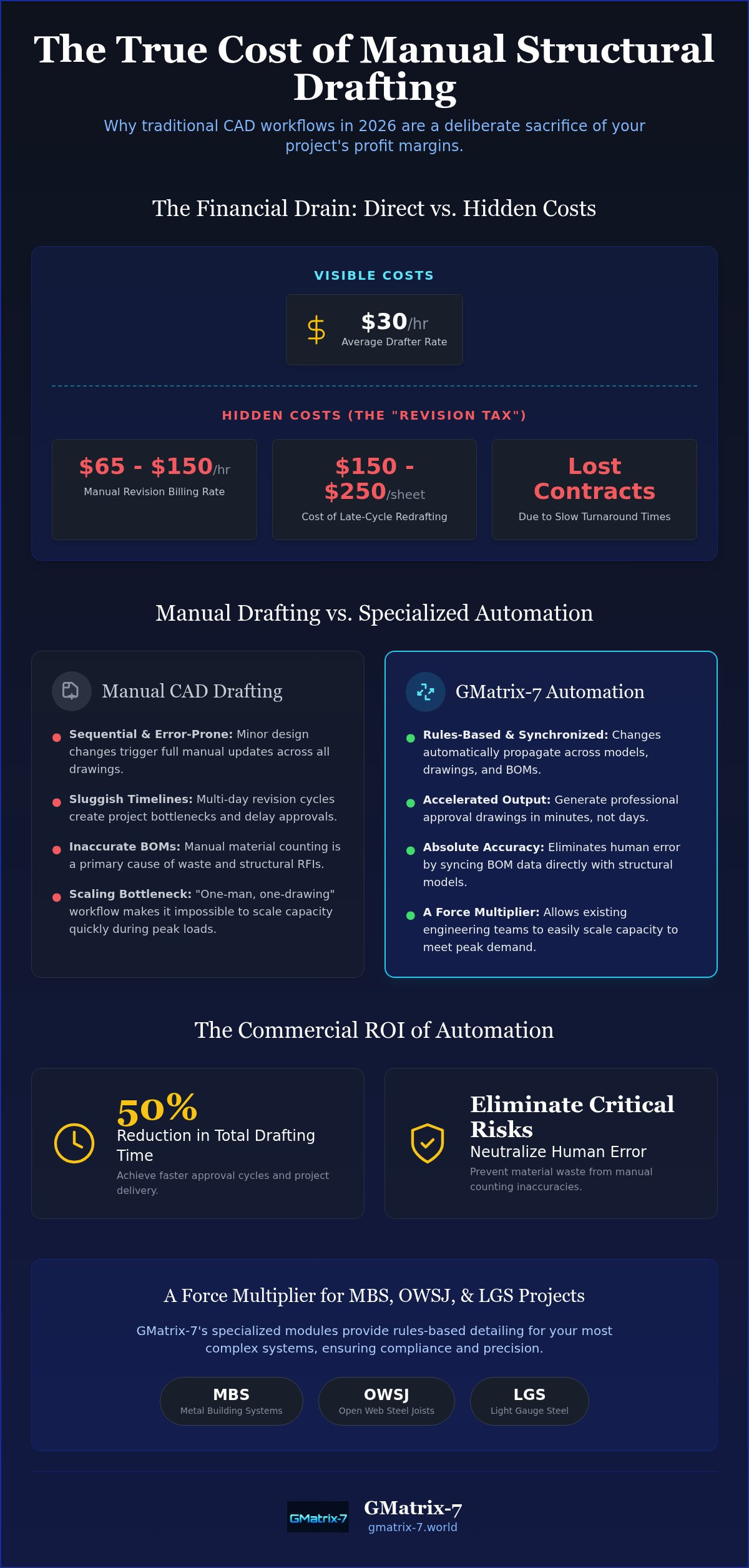
Quantifying the cost of manual structural drafting requires looking beyond the obvious line items of a balance sheet. Direct costs are the most visible; they include the average hourly rate of $30.04 for a structural drafter, alongside benefits, overhead, and general-purpose CAD subscriptions. However, these figures represent only the tip of the fiscal iceberg. The true financial drain lies in the "Revision Tax," where manual drafting revisions typically bill between $65 and $150 per hour. When architectural changes occur late in the design cycle, a manual workflow forces a complete, non-automated re-drafting of affected sheets, which can cost between $150 and $250 per sheet in lost productivity.
Opportunity costs further erode project margins. In a competitive 2026 market, slow turnaround times on approval drawings lead to lost contracts and strained client relationships. A manual process is a static process. It lacks the agility to respond to rapid project delivery demands, often resulting in expensive bottlenecks that delay the entire construction schedule. Engineering firms that fail to modernize their detailing workflows find themselves paying a premium for inefficiency while their more agile competitors secure high-value projects. Implementing automated detailing solutions is the only way to reclaim these lost margins and stabilize project budgets.
The Labor Burden of Manual Detailing
A standard Metal Building System (MBS) project requires hundreds of man-hours to generate a comprehensive approval set when handled manually. The challenge is compounded by the increasing difficulty of finding and retaining detailers who possess deep mastery of AISI S100 and SJI standards. This scarcity of specialized labor drives up wages and creates a single point of failure within the engineering team. Manual workflows struggle to absorb the 2026 demand for rapid project delivery because they rely on linear human effort rather than scalable, rules-based logic. This reliance creates a ceiling on your firm's growth potential.
The Cost of Manual BOM Generation
Manual Bill of Material (BOM) generation is perhaps the most high-risk phase of traditional drafting. Detailers spend hours manually counting bolts, plates, and structural members, a process that is notoriously prone to human error. Even a conservative 2% error rate in a manual material list can have catastrophic financial consequences. These inaccuracies lead to on-site material shortages, emergency procurement costs, and cascading delays that can derail a project's profitability. Automated BOM generation eliminates this risk by ensuring the material list is an exact, software-linked reflection of the structural model, providing the security and peace of mind that manual processes simply cannot offer.
Manual Drafting vs. Specialized Automation: A Performance Comparison
The performance delta between traditional methods and specialized automation has reached a critical threshold. While the cost of manual structural drafting continues to climb due to labor scarcity, automated systems provide a definitive escape from linear productivity constraints. Automation generates professional approval drawings in minutes. This represents a staggering contrast to the multi-day cycles required for manual CAD drafting. By integrating logic directly into the design phase, firms eliminate the lag between engineering intent and detailing output, transforming a historic bottleneck into a decisive competitive advantage.
Accuracy is no longer a variable dependent on a detailer's focus. Software-linked BOMs ensure that every bolt and plate in the material list is an exact reflection of the 3D geometry. This synchronization eliminates the discrepancy between drawings and material lists that historically plagues manual workflows. Compliance isn't a post-process check; it's an inherent feature. Modern tools integrate current IBC and SJI standards directly into the geometry, ensuring every member meets rigorous global standards from the inception of the model. This creates a level of reliability and security that manual processes simply can't replicate.
MBS and OWSJ Detailing Efficiency
Automating the complex geometry of Metal Building Systems (MBS) represents the ultimate force multiplier for engineering teams. Manual drafting for these systems is notoriously slow and prone to interpretative errors that delay fabrication. Utilizing specialized MBS IBC design software allows firms to generate precise approval sets that adhere to the strictest building codes without manual intervention. For Open Web Steel Joists (OWSJ), SJI-compliant detailing is now an automated standard. Manual checks are no longer competitive in an industry where speed and safety are non-negotiable requirements for high-level achievement.
LGS and Cold-Formed Steel Precision
Light Gauge Steel (LGS) projects present a unique challenge due to the high density of components and intricate connections. In these scenarios, the cost of manual structural drafting becomes prohibitive as the sheer volume of members increases the risk of human error. Specialized LGS structural design software automates AISI S100 compliance, effectively reducing the "technical debt" accumulated through manual drafting. This automation ensures that every cold-formed section is optimized for material efficiency and structural integrity. It allows a single team to handle five times the project load compared to traditional manual methods, providing the scalability needed to dominate the 2026 market.
Quantifying the Impact of Human Error in Structural Detailing
Human error in manual drafting remains the primary driver of structural Requests for Information (RFIs). It's a systemic failure that compromises project schedules and budgets alike. The hidden cost of manual structural drafting manifests most destructively on the job site when a single mislabeled joist or an incorrect baseplate dimension halts construction. These errors force expensive field fixes and emergency re-fabrication, often costing thousands of dollars in labor and idle equipment. Beyond immediate financial losses, manual calculation transcription introduces significant insurance and liability risks that can haunt a firm for years. Automation acts as a rigorous guardian of safety, ensuring that structural integrity is never compromised by a clerical oversight.
Relying on human interpretation for repetitive technical tasks creates a baseline of risk that modern projects can't afford. When a detailer manually transfers dimensions from an engineering report to a CAD sheet, the probability of a transposition error is high. These mistakes aren't just technical glitches; they are threats to the stability of the built environment. Transitioning to a rules-based system ensures that every output is a direct, unadulterated reflection of the engineering logic. This shift provides the peace of mind that comes from knowing your documentation is intellectually rigorous and fundamentally secure.
The RFI Bottleneck
Manual drafting inconsistencies frequently lead to weeks of project delays as teams scramble to resolve conflicting data. Each RFI carries a heavy administrative cost, requiring hours of coordination between engineers, detailers, and fabricators to rectify simple drawing mismatches. By providing error-free automated documentation, firms build a reputation for world-class reliability. Fabricators trust drawings generated through a unified data stream because they eliminate the friction of second-guessing manual inputs. This trust accelerates the fabrication cycle and secures your position as a preferred engineering partner.
Compliance Risks in 2026
Maintaining manual compliance with IBC 2024 updates is an unnecessary risk factor for any serious engineering firm. The complexity of modern codes requires a data-driven approach to ensure absolute safety. For instance, generating precise load tables for composite decks manually is a high-stakes task where a single decimal error can lead to catastrophic structural failure. Automated tools ensure every calculation aligns with the latest standards, such as SJI 100-2020 and AISI S100. To stay ahead of these regulatory shifts, review the Professional structural design automation outlook for 2026. Secure your firm's future and eliminate transcription risks by integrating GMatrix-7 specialized engineering modules into your workflow today.
Transitioning to GMatrix-7: Reducing Drafting Overheads
The transition from manual processes to specialized automation is no longer a luxury but a commercial necessity. While the cost of manual structural drafting remains a significant burden on project margins, GMatrix-7 provides a definitive solution through intelligent, rules-based automation. GMatrix-7 modules for MBS, OWSJ, and LGS replace traditional hand-crafted CAD workflows with high-velocity digital intelligence. This shift allows firms to generate precise composite deck load tables and comprehensive Bill of Materials (BOM) instantly. By removing the need for manual interpretation, you achieve a level of accuracy that manual drafting simply cannot match. It's about securing your projects with software-validated IBC, SJI, and AISI compliance while simultaneously stripping away the overheads that stifle growth.
Empower your existing team to produce 5x the output without increasing headcount. This isn't just about speed; it's about the pride of high-level achievement and the peace of mind that comes from a stable, error-free workflow. When you eliminate the clerical friction of manual detailing, you unlock the true potential of your engineering staff. They move away from the tedious correction of drafting errors and toward the optimization of structural systems. This transformation ensures that your firm remains both technologically advanced and fundamentally secure in a volatile market.
A Force Multiplier for Structural Engineers
GMatrix-7 acts as a force multiplier by automating the low-value, repetitive tasks that historically consume 80% of a detailer's time. Moving from "drafting" to "engineering" allows your team to focus on complex design challenges rather than line-by-line CAD input. We streamline the entire workflow from initial design to the final bill of materials, ensuring data integrity at every step. This efficiency provides a decisive competitive advantage, allowing you to offer significantly faster lead times to clients. In 2026, the ability to deliver accurate approval drawings in hours rather than weeks is what separates industry leaders from the rest of the field.
Implementing GMatrix-7 in Your Workflow
Adopting GMatrix-7 doesn't require a total overhaul of your existing infrastructure. Our modular approach allows for targeted implementation based on your specific needs, whether you're focusing on Metal Building Systems (MBS), Open Web Steel Joists (OWSJ), or Light Gauge Steel (LGS). This transition from manual CAD to automated engineering documentation is methodical and logical. It mirrors the professional workflow your team already understands but removes the manual bottlenecks that cause delays. Stop allowing the cost of manual structural drafting to erode your profitability. Schedule a consultation to calculate your drafting ROI with GMatrix-7 and take the first step toward world-class detailing efficiency.
Securing Your Industrial Future through Detailing Excellence
The era of accepting high overheads as an inevitable component of steel detailing is over. We've demonstrated that the true cost of manual structural drafting is not found in the baseline hourly wage, but in the cumulative friction of error-prone revision cycles and the inherent risks of non-compliance. Transitioning to rules-based automation allows your team to achieve 50% faster approval cycles while maintaining absolute precision in every Bill of Materials. This shift transforms your engineering department from a bottleneck into a world-class center of efficiency and high-level achievement.
GMatrix-7 provides the reliability of SJI 100-2020 and IBC 2024 compliance, empowering your firm to generate professional documentation that is trusted by global structural steel fabricators. By automating the generation of approval drawings and BOMs, you effectively neutralize the technical debt of legacy CAD workflows and reclaim your project margins. It's time to move beyond the limitations of manual input and embrace a data-driven standard of excellence. Optimize your engineering workflow with GMatrix-7 automation. Take command of your output and lead the industry with a workflow that is both technologically superior and fundamentally dependable.
Frequently Asked Questions
Is manual structural drafting still used in 2026?
Manual structural drafting persists in 2026 primarily as a legacy process within the conceptual design phase. However, it's no longer a viable standard for final shop drawings or complex industrial projects. Relying on hand-crafted CAD entries creates a significant bottleneck that increases the cost of manual structural drafting through slower turnaround times. Most world-class firms have transitioned to automated workflows to maintain the precision and speed required by modern global standards.
How much time can automation save compared to manual structural drafting?
Automation delivers a minimum 50% reduction in total drafting time compared to traditional manual methods. While a manual detailer might spend days interpreting calculations and drawing individual sheets, specialized software generates comprehensive approval sets in minutes. This acceleration acts as a force multiplier for your engineering team. It allows a single department to manage up to five times the project volume without expanding their current headcount or sacrificing the technical accuracy required for global industrial projects.
What are the most common errors in manual structural detailing?
The most frequent errors include mislabeled structural members, incorrect baseplate dimensions, and critical discrepancies between the drawing set and the Bill of Materials. These human oversights are the primary driver of on-site RFIs, significantly inflating the cost of manual structural drafting through emergency re-fabrication. Manual transcription of engineering data is inherently risky. Automation eliminates these vulnerabilities by ensuring that every dimension and material count is a direct, software-validated reflection of the underlying structural logic.
Does automated drafting software require extensive engineering training?
Automated drafting solutions are designed to leverage your team's existing professional knowledge rather than replace it. While a high level of industry expertise is still required to oversee the design, the software automates the tedious, rules-based tasks that typically consume a detailer's day. This shift allows your staff to focus on high-value optimization. It effectively lowers the technical barrier for producing complex, code-compliant documentation for MBS, OWSJ, and LGS structures without requiring a total workforce overhaul.
How does GMatrix-7 handle specialized components like bar joists or composite decks?
GMatrix-7 utilizes specialized modules tailored to the unique requirements of bar joists and composite decks. The OWSJ (SJI) module automates the detailing of bar joists according to the latest SJI 100-2020 standards. Simultaneously, our load table generator produces precise data for composite decks and sandwich panels. These tools integrate complex compliance rules directly into the geometry. This ensures that specialized components are both structurally sound and ready for immediate fabrication with zero manual intervention.
Can automated BOMs really eliminate material waste in steel fabrication?
Automated Bill of Material (BOM) generation is a definitive tool for eliminating material waste. Manual counting is notoriously prone to a 2% error rate, which leads to expensive on-site shortages or over-ordering. GMatrix-7 links the BOM directly to the structural model, ensuring that every bolt, plate, and member is accounted for with absolute precision. This synchronization provides the security and peace of mind that your material procurement is optimized and entirely error-free, protecting your project's bottom line.
What is the ROI for switching from manual drafting to GMatrix-7?
The return on investment is realized through three primary channels: labor efficiency, error reduction, and increased capacity. By slashing drafting time by 50% and eliminating the "Revision Tax" associated with manual errors, firms see an immediate stabilization of project margins. The ability to produce five times the output with your existing team significantly increases your firm's revenue potential. This transition ensures long-term stability and a world-class competitive advantage in the 2026 market.


